Japan and South Korea Deepen Cooperation to Address Regional Tensions
Japan and South Korea commit to stronger security, economic, and diplomatic cooperation, enhancing regional stability amid rising East Asia tensions.
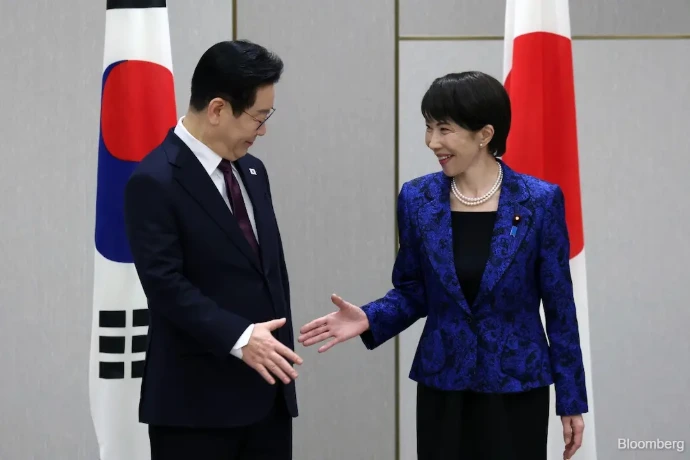
Japan and South Korea have reaffirmed their commitment to deepening security, economic, and diplomatic cooperation to address rising tensions in East Asia. The pledge came after a summit between Japanese Prime Minister Sanae Takaichi and South Korean President Lee Jae Myung in Nara.
In a joint statement, both leaders emphasized the importance of bilateral relations and trilateral coordination with the United States to ensure regional stability, peace, and shared prosperity.
Key discussions focused on industrial supply chains, artificial intelligence, denuclearization of the Korean Peninsula, and regional security, along with joint efforts to combat cross-border online scams affecting citizens in both countries.
President Lee highlighted the urgency of stronger ties amid global uncertainty, noting the volatile international trade and security environment. Prime Minister Takaichi stressed that closer Japan-South Korea cooperation is essential for regional resilience.
The summit took place amid rising geopolitical tensions in East Asia, including evolving dynamics involving China and Taiwan. President Lee affirmed that South Korea would not intervene in Japan-China disputes, emphasizing that diplomatic tensions hinder regional peace.
Both leaders acknowledged historical challenges, particularly related to Japan’s colonial rule of the Korean Peninsula. Prime Minister Takaichi welcomed progress in efforts to identify wartime human remains of Korean and Japanese workers at an abandoned coal mine in western Japan.
The governments plan to continue shuttle diplomacy, maintaining high-level exchanges to sustain momentum in bilateral relations. Prime Minister Takaichi is expected to visit South Korea for the next summit, marking the third meeting between the two leaders.
The talks reflect a shared determination to advance pragmatic cooperation, address historical issues, and promote stability, security, and prosperity in the region.